Brady’s wheelchair bomb
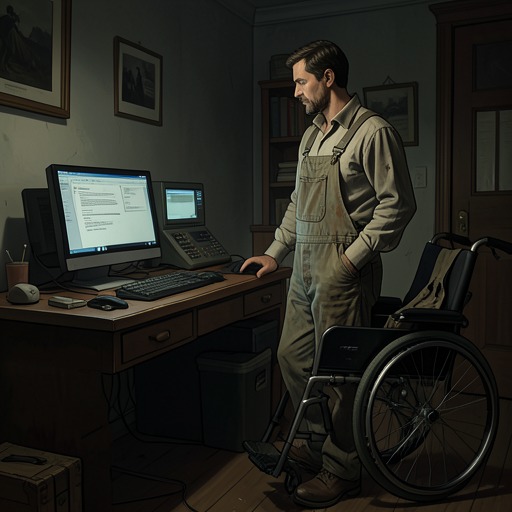
Mr. MercedesBrady’s wheelchair bomb is a makeshift explosive device designed to turn an ordinary mobility aid into a weapon against concertgoers at the Mingo Auditorium. Built around an explosives-laden cushion, additional charges, ball bearings, and the Thing Two trigger, it embodies Brady’s escalation from the City Center massacre to a larger intended attack. Its conspicuous flaws—visible wires, accessible storage pockets, and an improvised assembly—become central to the tension: the device is dangerous, but it is also repeatedly vulnerable to being noticed and stopped.
Construction and Components
Brady assembles the bomb in a Motel 6 room, where he unfolds a wheelchair he has bought and places the ASS PARKING cushion on its seat. He cuts open the lining of the rear pocket and adds blocks of homemade plastic explosive, each fitted with a lead azide blasting plug. He gathers their connecting wires with a metal clip, intending to braid them into a single master wire. The actual detonator is Thing Two, making the wheelchair not merely a container for explosives but the platform for a deliberately assembled electrical triggering system.
He adds another layer of destructive force by taping Baggies of ball bearings beneath the seat, securing them with crossed strips of filament tape. The construction is laborious and improvised: explosive blocks, plugs, wires, bearings, cushion, and wheelchair are joined into a single device by hand. Looking at the finished work, Brady recognizes that he does not know whether he can get the rolling bomb into the auditorium. He reassures himself by recalling that he had also doubted his ability to escape after the City Center attack. This time, he reasons, he will not need to escape—a calculation that makes the device part of a plan in which his own survival has ceased to be a necessary condition.
Final Assembly at the Venue
Brady arrives at the Midwest Culture and Arts Complex shortly before six in the evening, while the parking lot is filling and long lines are forming. He cannot make his final preparations in plain view, so he uses a parked tractor-trailer box, at least fifty feet long, to hide the Subaru from the crowd. Wearing fake glasses, he retrieves the wheelchair from the car and connects the wire coming through the center of the A in PARKING to wires extending from pockets that contain more plastic explosive. A further wire from a rear-pocket charge protrudes through a hole in the seatback.
Sweating, Brady braids the copper cores together and wraps the exposed connection points with masking tape. He has stuck pre-cut strips of tape to the front of an oversized ’Round Here T-shirt bearing the band’s Ferris wheel logo. The shirt’s words, KISSES ON THE MIDWAY, and its message of devotion to the band make a piece of concert merchandise part of the practical work of bomb assembly. After about ten minutes, the connected wires lie across the seat like a web. Brady cannot work out how to wire in the explosives-stuffed Urinesta peebag on short notice, but decides that the other charges should be enough.
Before leaving the car, Brady takes an eight-by-ten framed picture of Frankie holding Sammy the Fire Truck. He kisses the glass and speaks to his dead brother, then pretends Frankie has agreed to help him. Back at the wheelchair, he sits on the ASS PARKING cushion and connects the master wire to Thing Two. The device’s power switch produces a yellow ready lamp rather than an immediate failure, but the successful test does not resolve the larger uncertainty: Brady admits to himself that the plan is crude and that he may not know whether it works until the moment of detonation.
Design Flaws and Brady’s Fatalism
The bomb’s intended path through the venue is threatened by a clear security rule: NO BAGS NO BOXES NO BACKPACKS. Brady has none of those items, but he also has not properly concealed the wheelchair’s storage pockets, and a wire remains exposed. He has put a ’Round Here pennant in one pocket, but the decoration does little to disguise the construction. A guard looking closely at the wheelchair could see that it is a rolling bomb; a sharp-eyed guard could notice the wire even sooner. The device therefore depends less on effective concealment than on passing through security without attracting sustained inspection.
Brady understands these weaknesses but treats them as reasons to accept the risk rather than revise the plan. He compares his expectations with the City Center attack, where he had relied on a mask, a hairnet, and bleach to destroy DNA evidence, and recalls that he had never truly expected to escape. He cannot decide whether his present attitude is confidence or fatalism, but the distinction has lost importance to him. The bomb’s rough workmanship and open vulnerabilities are not incidental technical details: they express a plan undertaken by someone who expects little from the future and places no serious value on his own survival.
The Security Checkpoint and Intended Trigger
At the checkpoint, MAC Security staff inspect some, but not all, of the storage pockets on wheelchairs. Brady sees that they check roughly every third or fourth chair, sometimes two in succession, and his confidence in slipping through begins to cool. He had assumed that even if security stopped him, the explosion could still kill concertgoers gathered near the doors. The inspections make that fallback uncertain as well. He nevertheless measures the prospective toll against City Center, where he killed eight people, and convinces himself that he is bound to do better.
As he rolls forward, Frankie’s framed picture rests on his lap, with its edge against the toggle switch on Thing Two. Brady’s plan is to press down on the picture when a security guard bends to inspect the wheelchair’s pockets. The yellow ready lamp will turn green, sending electricity to the lead azide detonators in the homemade explosive. By the time the wheelchair reaches the checkpoint, the crowded corridor is packed with singing girls, and Brady imagines a much higher death toll. When a security woman asks about the photograph, he presents himself as a bereaved, disabled father bringing his dead child to hear the band. The picture thus serves at once as a keepsake, a cover story, and the object positioned over the trigger.
The device’s threat is made physically legible when Holly warns a girl in another wheelchair not to touch Brady because he has a bomb and she thinks it is hot. Holly sees a dim yellow light beneath his shirt. Later, Jerome restrains Brady’s hands while Holly examines the apparatus: the yellow light comes from a plastic gadget resembling a customized television remote, with a white toggle switch standing upright and a wire running beneath Brady. The mechanism has ceased to be merely a hidden plan; its visible signal and exposed wiring make the danger immediate to the people beside it.
Narrative Function and Significance
The wheelchair bomb is built from the opposition between its ordinary appearance and its intended violence. A wheelchair, a concert shirt, a framed family photograph, and a urinal bag are repurposed within a design that depends on their being read as harmless or personal. Yet the construction does not achieve reliable concealment. The protruding wires, inspectable pockets, and visible lamp repeatedly expose the device’s material presence, while the checkpoint’s searches turn its imperfections into immediate dramatic risks.
The plan also carries forward Brady’s history without simply repeating the City Center attack. He explicitly compares the two operations, remembering that the first required little planning and that he had expected not to escape. Now he has spent time assembling a more complex device, but its complexity has not produced control: the bomb remains crude, its passage through security uncertain, and its trigger tied to an improvised arrangement involving a photograph of Frankie. The wheelchair bomb’s significance lies in that contradiction. It promises a larger massacre while displaying, in its very construction, the instability and fatalism of the person who built it.